MB100 Global LeadersMeaningful Business
2026

Trusted by governments. Backed by institutions. Chosen by millions.
The problem, and the answer
Drinkwell breaks the water sector's Build, Neglect, Runaway cycle with a Build, Operate, Regenerate model that pairs proprietary water filtration resins with public-private partnerships. In Build, Neglect, Runaway the private sector is a contractor: paid to build, gone by year two. In Build, Operate, Regenerate it is a true partner, paid for the water that flows and still there in year ten. That is the private sector participation it takes to serve everyone, forever, and truly end the water crisis.
#PartnerNotContractor
Drag the year, or let it run.
The sector's way
Build. A capital budget is spent and a deployment is commissioned. This part works, and it is the part almost everybody is willing to fund.
Neglect. Year two arrives with no operating budget. Media exhausts, a pump fails, a repair has no line item, and output falls long before anyone records that it has.
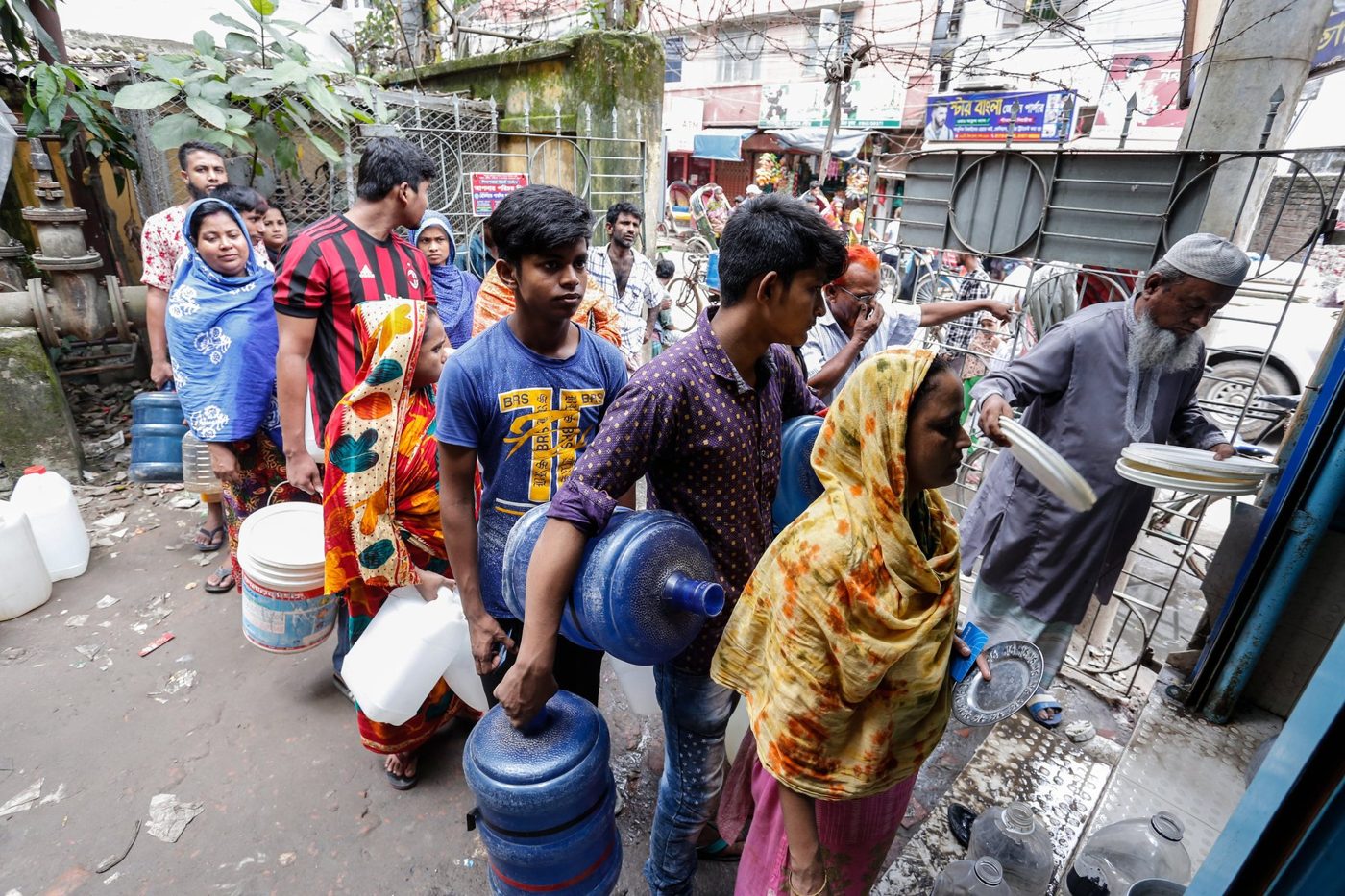
Runaway. Whoever built it is already somewhere else. Households go back to the tubewell they were warned about, and the next programme puts a new deployment beside the defunct one.
Ten years, four deployments, one still running.
The Drinkwell way
Build. A deployment engineered to the basin it draws from, commissioned with the operator named and the operating budget identified before the ribbon is cut.
Operate. Our own crews and remote monitoring keep the deployment producing water, paid per litre delivered rather than per plant shipped.
Regenerate. Every six to twelve months the media is regenerated on site and put back to work. No replacement, no landfill, no new deployment beside the old one.
Ten years, one deployment, still running.
The promised land
The utility's plant treats the aquifer for the wards the pipe reaches. A prepaid Water ATM two hundred metres from home serves the wards it reaches badly, at the utility's own tariff. A tabletop filter serves the households it never will. The same operator runs all three, every plant carries a public A to F grade, and the media in every one of them is regenerated instead of replaced: on site at the piped plant, back at the factory for kiosk cartridges and filter candles.
In the field
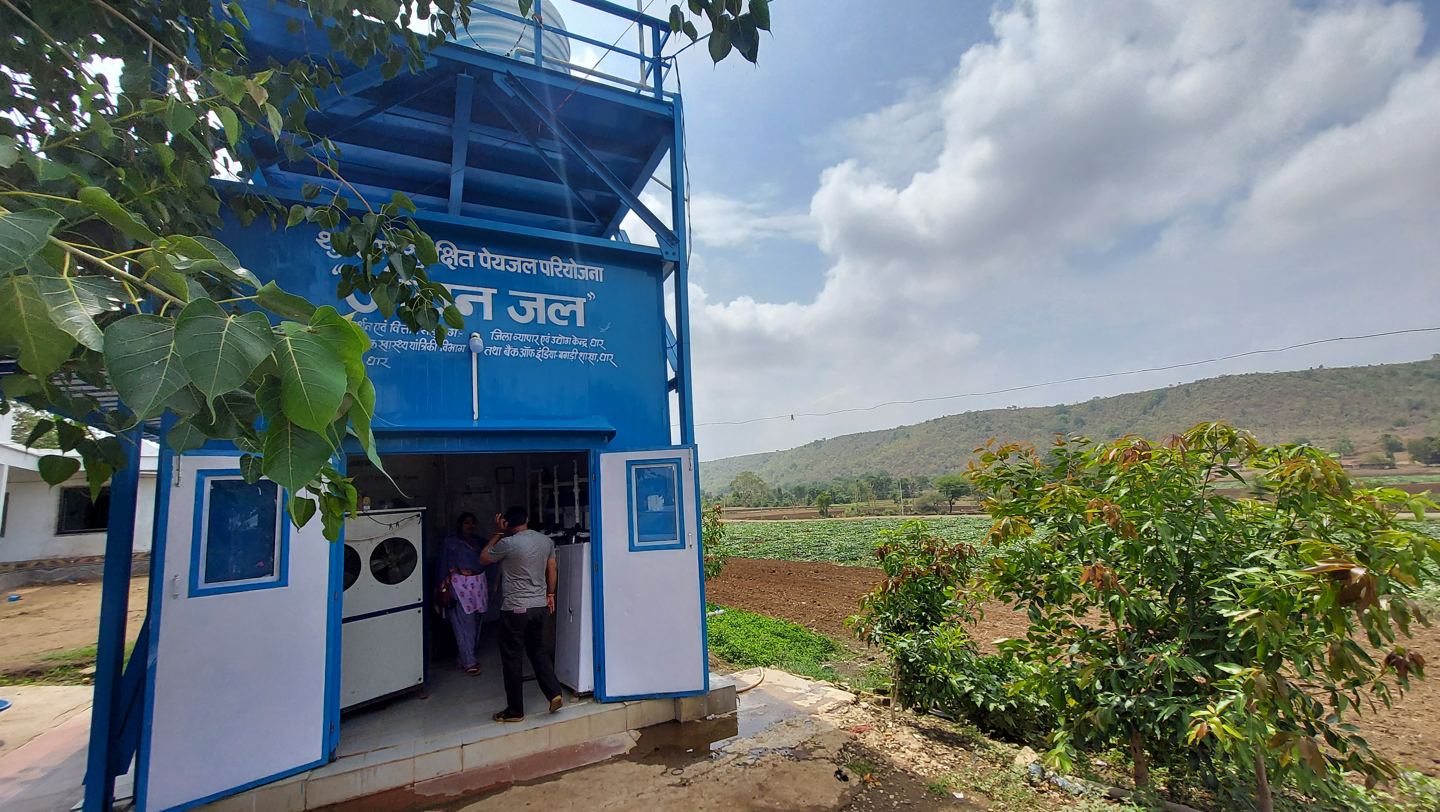
Drinkwell system, Borigaon village, Nalbari, Assam (3.5 min)
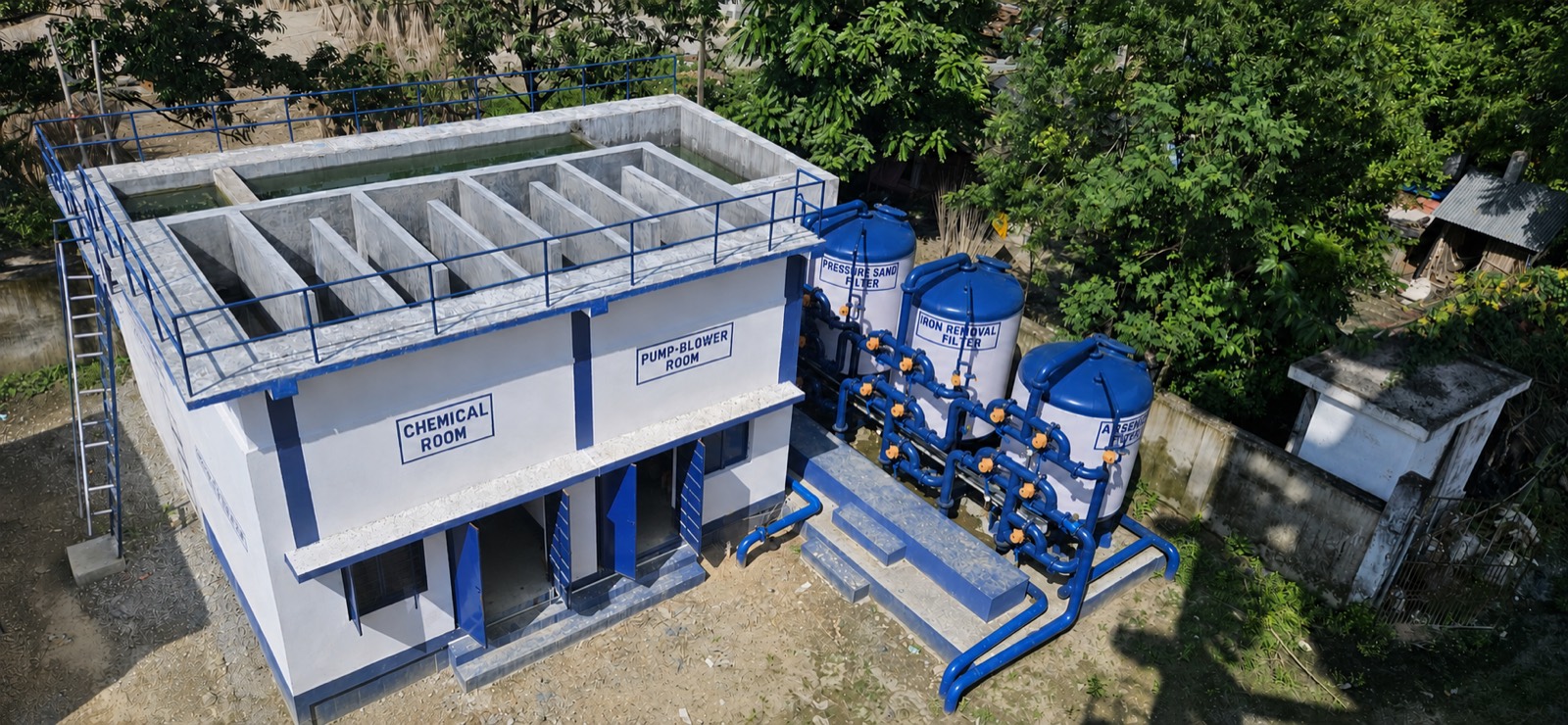
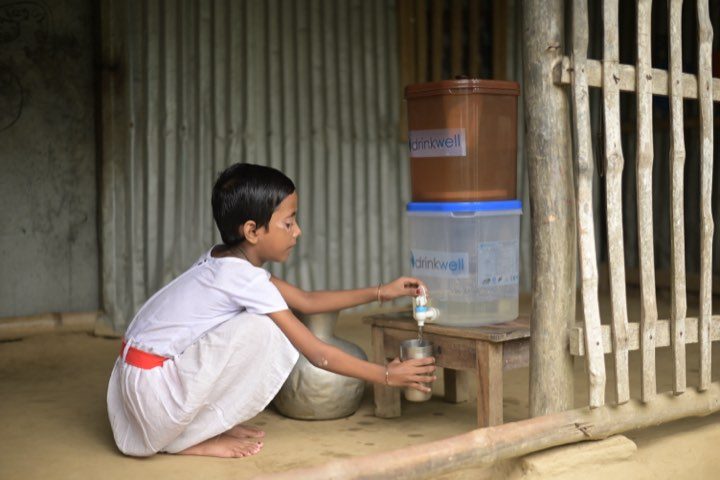
Domestic arsenic & iron filter (1.5 min)
Our approach
Five words we use internally for every site we run: a habitat, a horse, a harness, hay, and a habit. A plant keeps producing water only when all five are in place, and four out of five is how you get the cycle above. The rest of this page takes them one at a time.
All five gears turning together is what powers safe water for everyone, forever.
The aquifer or river a site draws from, what is in it, and how that changes with the seasons. It decides the treatment train before anyone draws one.
Chapter 01The chemistry and the vessels around it that turn raw water into safe water, efficient enough that treated water can be sold for a fraction of a rupee per litre.
Chapter 02The form the train arrives in, sized to the geography: a household filter, a kiosk, or a government piped scheme.
Chapter 03The money that covers running costs after commissioning. Tariffs, taxes or transfers, named site by site.
Chapter 04The operator on the ground, the regeneration schedule, and the work of keeping people coming back to the tap long after the ribbon is cut.
Chapter 0501 · The habitat · the basin
Every site starts with its source: the aquifer, river or pond it draws from, what is in that water, and how it changes between the dry season and the monsoon. A raw-water analysis decides the treatment train before anyone draws one, and where the source itself can be improved, that comes first.
Arsenic, fluoride, iron, manganese, nitrate, hardness, salinity, pH and bacteria, tested in an accredited laboratory and read against IS 10500 in India and the Environment Conservation Rules 2023 in Bangladesh. The train is sized to the result, or we say plainly that ion exchange is the wrong tool for that water.
Treated water is sampled on a fixed schedule and tested by independent laboratories: icddr,b, NGO Forum, SGS, BUET and BSTI in Bangladesh, CSIR laboratories in India. Every report is kept in one register, so a plant's grade rests on a test, not a claim.
Rooftop and community rainwater harvesting, pond-sand filters, managed aquifer recharge and source protection, so there is less in the raw water for any treatment train to remove. Our Majuli and Nalbari programme with Safe Water Network (2020–22) carried a rainwater-harvesting mandate.
02 · The horse · the treatment train
HIX-Nano is our proprietary hybrid ion exchange media: a durable polymer bead, about 0.5 mm across, impregnated with iron and zirconium oxide nanoparticles. The polymer gives it the strength to survive years of flow and hundreds of bed volumes; the nanoparticles give it an enormous internal surface that binds arsenic, fluoride and iron selectively in near-neutral groundwater, on contact, while harmless minerals pass through. A rinse of 2% salt and 2% caustic then makes every binding site let go at once, so the same bead is regenerated on site and put back to work instead of going to landfill. Invented in the USA, manufactured in our own plant in Kolkata, and listed in the Ministry of Jal Shakti's Mashelkar Committee compendium.

One media platform
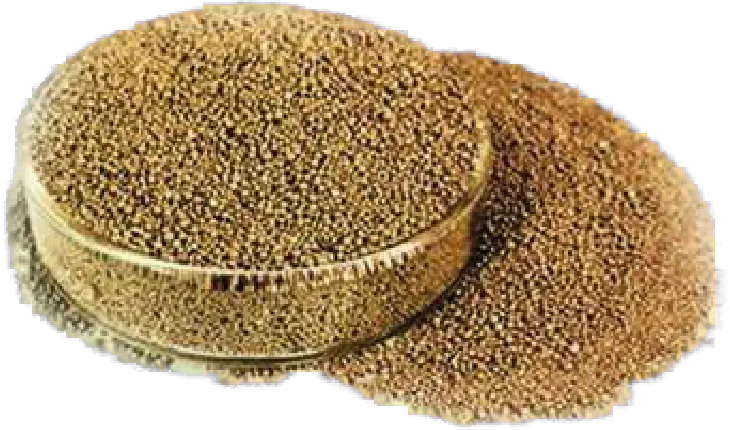
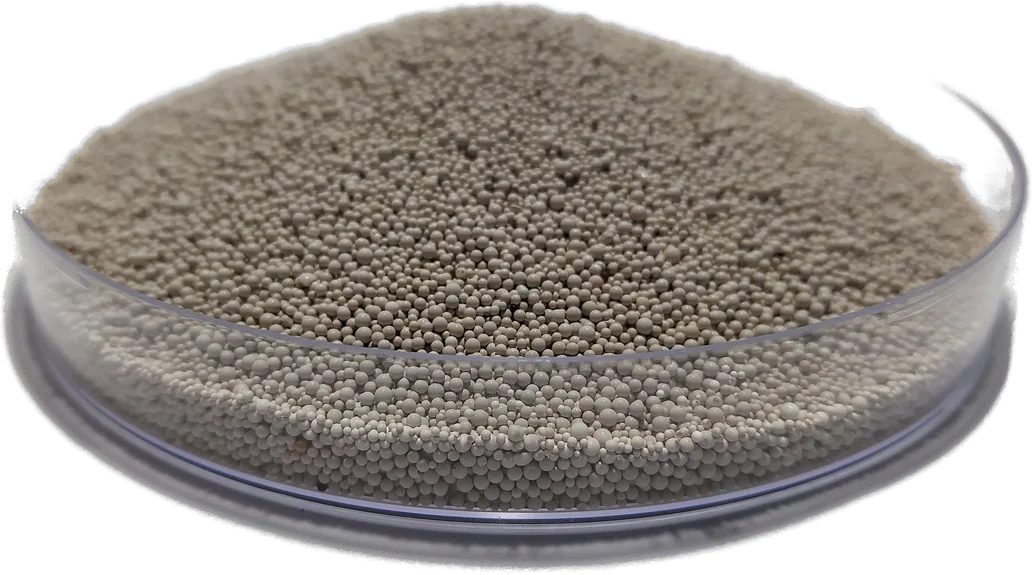
Listed in the Ministry of Jal Shakti's Mashelkar Committee compendium. CSIR approved. The family extends to HIX-Nano™ 300 (hardness), 400 (nitrate) and 500 (ammonia).
What we remove
Every contaminant on this list is one we have been paid to remove.
How we reduce TDS
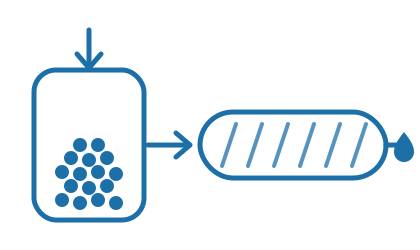
Dissolved salts do not bind to an ion-exchange bead, so salinity is the one job we hand to a membrane. HIX-RO runs raw water through a HIX bed first, stripping the iron, arsenic and hardness that foul and scale membranes, then through reverse osmosis. The membrane lasts longer, recovers up to 80% of the feed against about half for a conventional RO plant, and uses roughly half the energy.
How HIX-Nano works
Conventional media fills up with whatever the water is carrying and then goes to landfill. HIX-Nano is selective about what it binds and gives it back during regeneration, which is why one charge lasts five to ten years instead of one season. Inspired by, and sourced from, our impact report.
How one charge lasts a decade
Iron and zirconium oxide nanoparticles are fixed irreversibly inside a macroporous polymer bead. They hold arsenic and fluoride against sulphate, chloride and bicarbonate at hundreds of times the concentration — the selectivity is the whole trick.
Every 6 to 12 months our crew runs a caustic and brine cycle on site. The contaminant comes off, the media goes back into service, and the waste leaves as a few litres of sludge rather than a bed of spent adsorbent.
The nanoparticles do not wash out, so the bead survives the cycle. Five to ten years per charge, then the media is replaced and the vessel keeps running.
See it in action
Watch it work
Both demos are ported from our impact report, which carries the peer-reviewed source behind every number in them. See the sources
Media specification
Operating capacity depends on influent concentration, pH and competing ions. Figures are from the HIX-Nano™ 100+ product data sheet; the treated-water limits, recovery and service life are in the bead section above.
Circular by design
The media is regenerated on site with a caustic and brine rinse, restoring capacity. No replacement, no new plant beside the old one.
One charge survives repeated regeneration cycles, which removes the annual replacement that single-use filters depend on.
Containers from our jar-delivery network are collected, cleaned and returned to service instead of leaving as plastic waste.
Built for the field
The bead carries iron and zirconium, both stable and non-hazardous, and is manufactured in our own plant in Kolkata.
A single-stage process run by a trained local operator. No specialist technician is needed day to day.
Media, vessels, controls and operations come from one company, so there is nobody else to wait for when something breaks.
About half the energy of conventional reverse osmosis, which suits rural sites where power is unreliable.
Against the alternatives
Stream width is the share of the water: blue is product delivered for drinking, amber is reject and rinse. Ion exchange passes the whole stream through the bed and loses only backwash and regeneration rinse — a few bed volumes per ten thousand treated. Published RO field figures are often worse than shown here, with half to four-fifths of the feedwater discarded.
Rejects everything, including the calcium and magnesium people need, and throws away half the water. HIX-Nano recovers 95–99% because it takes out one contaminant and leaves the rest of the water alone.
The default defluoridation media. In an identical column test at a 10 mg/L fluoride feed, alumina crossed the WHO limit before 600 bed volumes; the hybrid media ran past 1,400.
Every exhausted bed becomes contaminated solid waste somebody has to bury. Regeneration cuts that volume by about 95%, and the residual is contained rather than dispersed.
The HIX family
Supplied to qualified utilities, EPCs, OEMs and system integrators subject to technical qualification. Every one of them is regenerable and reusable.
Tabletop fluoride filter: User leaflet for the household filter
In the field
Independent validation
Tested in the laboratory and in the field, with letters and certificates from research institutions and government task forces. Every document is the original, as issued.
The evidence base
Two decades of peer-reviewed work sits behind this media, most of it published before Drinkwell existed and none of it ours to grade. The full bibliography, with the numbers each source actually supports, is on our impact site.
03 · The harness · the deployment
The same media is delivered in whatever form the geography needs. Every harness arrives installed and serviced, with trained local operators, remote monitoring and scheduled on-site regeneration.
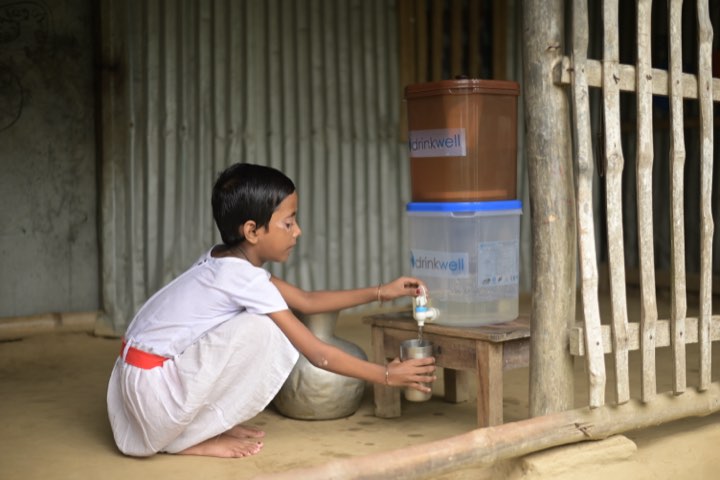
Tabletop and gravity-fed, for habitations a piped scheme has not reached yet.
See the sites
1,000+ litre-per-hour kiosks with prepaid card dispensing, metered to the litre.
See the sites
HIX slots into the treatment train of an existing government distribution network.
See the sitesSlide along the rail, or pick a harness, to see which one covers that output
Hand-pump retrofit to mega-PWS on one media and one regeneration model.
Deployments
Three kinds of deployment, one media platform and one operating model behind all of them. Choose a type to filter the map, or open a site to see what it is.
The map needs JavaScript. Every site is listed in the data file it draws from: deployments.json.
Household filters are shipped by the crate rather than sited individually, so they are not on this map. Find your nearest Water ATM at find.drinkwell.com
Card-operated dispensing, metered to the litre, mostly on a city utility network.
A treatment house and a counter, run by a trained local operator for one village or ward.
Our media inside a government distribution network, feeding household connections. Four schemes for West Bengal PHED are under construction; the one with a fix on the map is drawn hollow.
Platforms and components
Skid-mounted and modular platforms across a wide range of capacities, for new deployments and retrofits.
HIX pretreatment ahead of reverse osmosis where TDS has to come down, for higher recovery and less reject.
Automated dispensing with digital metering, RFID access and remote monitoring.
Gravity-fed, non-electric systems for households, schools, clinics and emergency response.
Electro-chlorination and electro-coagulation for disinfection and specialised treatment.
Media, components and technical support to bring an underperforming plant back without replacing it.
04 · The hay · the financing source
Building a plant and running it are paid for differently, and both need a payer before the ribbon is cut. Capital comes from a government budget, a development bank or a funder; operations come from one of three sources, tariffs, taxes or transfers. We record which one carries each site before commissioning, because a site carried by none of them has a date on it whether or not anyone has written that date down.
The Drinkwell Partner Network
The people drinking the water pay for it, metered to the litre and priced to be affordable daily rather than cheap once.
Water ATMs across Dhaka and Chattogram, and every prepaid-card kiosk.
utilities and city corporations that set the price at the tap
A public budget pays for treated water it has committed to supply to its own citizens.
PHED piped schemes under the Jal Jeevan Mission, billed on volume delivered.
public health engineering departments
Philanthropy, CSR and outcomes payments from outside the water system, used to carry the years before a tariff or a budget line can.
Catalytic capital placed against a defined handover, not an open-ended subsidy.
development banks, CSR, foundations and grant-makers
Debt is not a fourth source. Working capital from a development bank bridges against future tariffs, taxes or transfers. It does not replace them, and a site standing on debt alone is a site nobody has funded yet.
In kind, pro bono: EY Ripples, GLG Social Impact, Hogan Lovells.
05 · The habit · operation, maintenance and marketing
That one choice puts the cost of a stopped plant on us rather than on whoever inherited it. We finance, install, monitor and maintain every site we build, with our own crews on a regeneration schedule. A plant that stops running stops earning.
Revenue follows water actually delivered, not equipment sold.
Scheduled on site by our own crews. No media replacement, no landfill.
Flow, uptime and dispensing telemetered off every connected site.
Trained and paid in the community the plant serves.
What operating means
Day-to-day running, routine inspection, preventive maintenance, operator supervision and rapid response when service is disrupted.
Regular testing against the public authority's standard, with transparent reporting and early warning of a plant drifting.
Aligning with the utility's operating procedures, tariff decisions and oversight, so the plant is part of the network rather than beside it.
Assessing and reviving existing plants when source water changes or performance slips, for the long run rather than a quick fix.
Local operators and technicians who are known to the people they serve, so the plant is trusted, understood and used.
Structured private participation with public oversight: the utility keeps tariff authority and accountability, we keep the water flowing.
Work with us
Five gears turn at every site that keeps producing water. Whether you are buying a rainwater system, media by the cubic metre, or handing us a district, what changes is how many of those gears we turn for you after commissioning. Choose a rung to see the engine climb.
Rooftop and community rainwater harvesting, or managed recharge of the aquifer a site draws from, deployed and commissioned. Less in the raw water means less for any treatment train downstream to remove.
HIX-Nano by the cubic metre, with the regeneration protocol, for firms building their own treatment trains. You design it, you install it, you run it.
A complete plant, engineered to your raw water analysis and delivered ready to install. You commission it and hand it over to the client.
We bid the tender, build the scheme and run it under a multi-year operations contract, with our own crews and remote monitoring. A public budget pays for the water delivered.
We put in the capital, own the asset and are paid per litre dispensed. If the plant stops producing, our revenue stops with it.
The engine
All five gears turning is a site that keeps working. Fewer than five is a site with a date on it.
Read the gears as risk rather than as scope. Hay is the last gear we turn, because turning it means carrying the money ourselves instead of invoicing someone else for it.
Ways to work together
Impact
Parallel, philanthropically funded systems compete with the public utility, depend on the next grant and sit outside the national water plan. We integrate with the utility instead, co-creating the service and sharing the cost, so what we build is part of the system that is meant to last.
From inputs to outcomes
What we count
What changes, and when
Households move from the tubewell they were warned about to treated water, once the plant is there and the price is right.
Household conversion
Customers keep buying, which is the only proof that a plant is trusted rather than merely present.
Customer retention
A household that has stopped drinking arsenic or fluoride has stopped accumulating it. We measure the switch and the storage practice; the health literature already links the two.
Source switching and safe storage
Climate co-benefits
Ion exchange passes almost the whole stream through the bed, and a regenerated bead never becomes a bag of spent media. Households on treated water also stop boiling, which saves fuel and the carbon that goes with it.
Sustainable Development Goals
Less chronic exposure to arsenic and fluoride, less waterborne disease
Safe, affordable drinking water on a meter
Local operators and technicians paid in the community the plant serves

Water infrastructure that survives the decade and the weather
About
Drinkwell builds and operates safe-water infrastructure for beyond-the-pipe communities in South Asia, in partnership with the public and private sector, and regenerates its filters instead of replacing them. That halves what the filter costs over the life of a plant and keeps safe water accessible and affordable for everyone, forever.

Our story
Drinkwell was founded in 2013 on a simple observation: tens of millions of people in South Asia were drinking groundwater contaminated with arsenic and fluoride, and the treatment on offer was either too expensive to run or too complicated for a village to keep alive.
We commercialised HIX-Nano, a proprietary ion exchange media invented in the USA, and built the company around the part everyone else skips: staying to operate. Today the media is manufactured in our own plant in Kolkata and runs in more than 700 treatment plants across Bangladesh and India, from tabletop filters to an 83,000 litre-per-hour piped scheme.
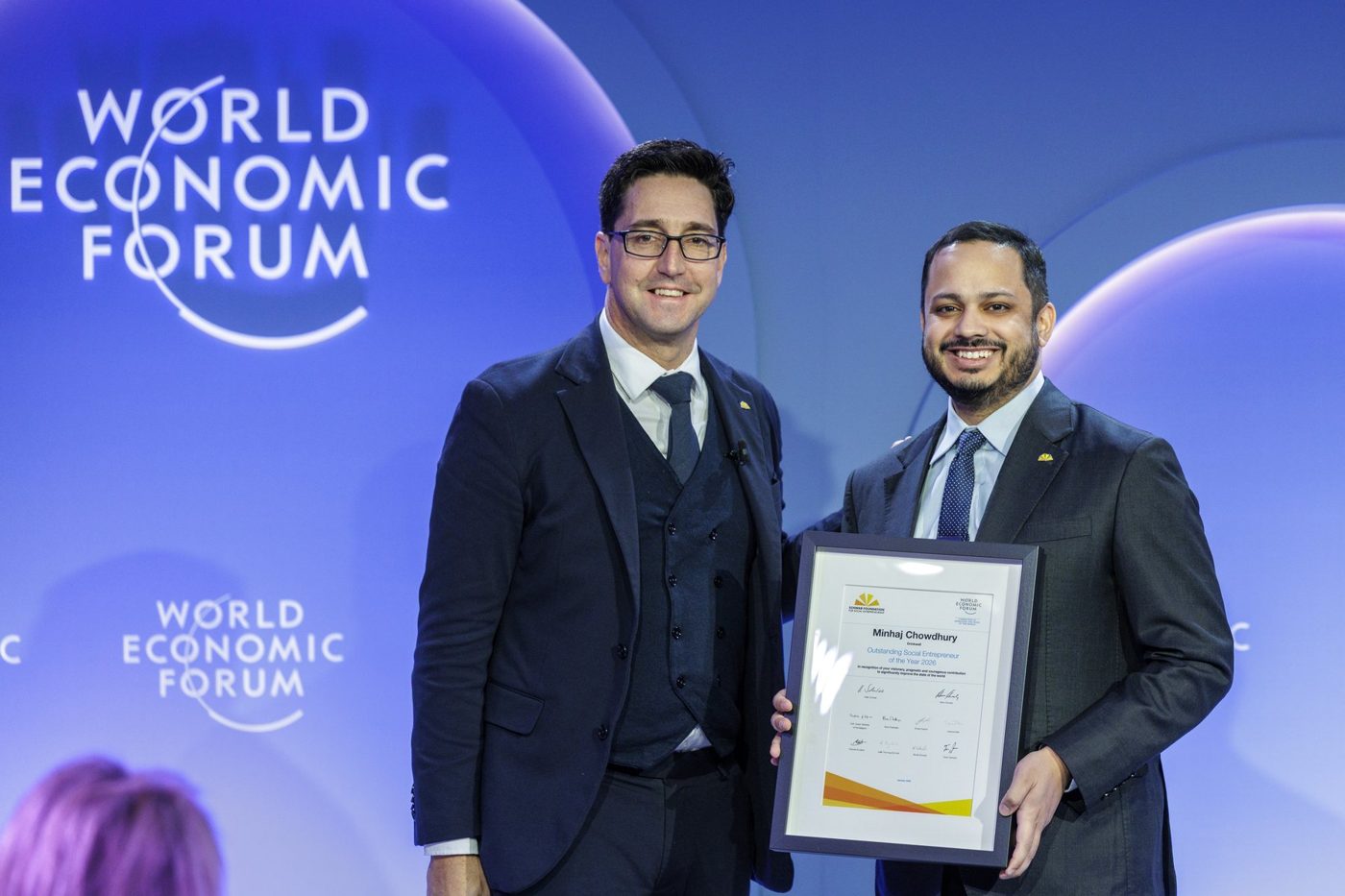
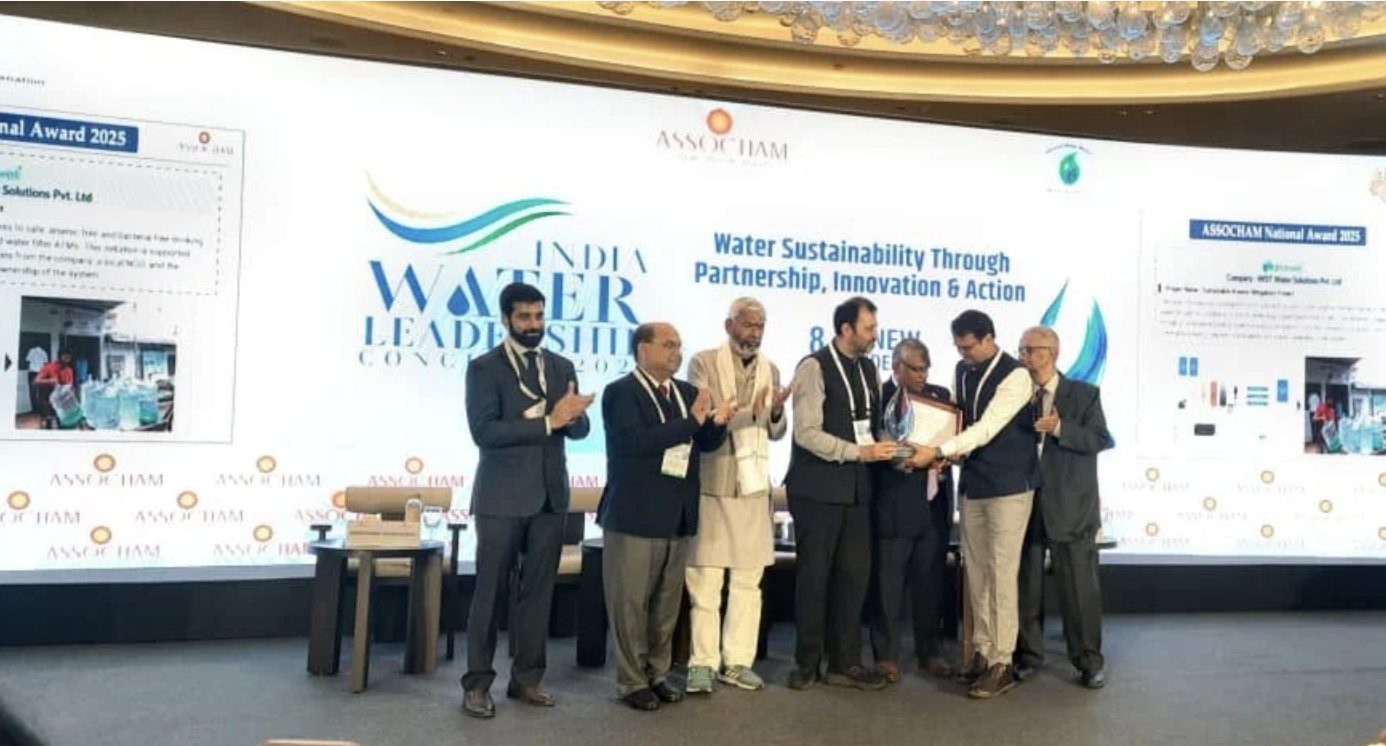
We are recognised by the World Economic Forum, the World Bank, the Asian Development Bank, UNICEF, the US State Department and the governments we serve as a pioneer of climate-resilient water infrastructure.
What drives us
We hold ourselves to the highest standard in technology, execution and impact measurement.
We adapt quickly, tailoring the plant and the service to the community and the water.
We build lasting relationships with communities, partners and institutions through transparency and reliability.
We listen to the people we serve and design for the needs they actually have.
We build infrastructure that endures: systems for communities facing uncertainty.
Board of directors
The board provides governance and strategic direction across technology, public-sector partnerships and long-term operating performance.
Twelve years executing community water systems. BA in Public Health from Johns Hopkins University. Fulbright Fellow, Ashoka Fellow, Echoing Green Fellow.
Commercialised HIX-Nano resins through his Fulbright Fellowship and doctoral research. BS Chemical Engineering, UMBC; MS and PhD Environmental Engineering.
Founding director of ITC InfoTech; previously DVP at PTC; board chair of Virtalis. BS Mechanical Engineering, NIT Kurukshetra; executive programmes at MIT Sloan and Wharton.
Founding partner of Peak Sustainability Ventures, a leading cleantech investor. Previously at Goldman Sachs. BCom and LLB, University of Mumbai; MBA, Wharton.
General manager of Danone Communities; serves on the boards of water and nutrition start-ups worldwide. DESS in Marketing, Sciences Po; executive programmes at HEC Paris and ESSEC.
Country leadership
The leaders who run Drinkwell day to day, build local partnerships and deliver safe water at scale.
Ten years leading Drinkwell's India operations. Forged partnerships with Tata Trusts, the Clinton Health Access Initiative, WaterAid and Public Health Engineering Departments across West Bengal, Bihar, Assam and Madhya Pradesh; leads a 20-person team and took the business to profitability. BCom, St Xavier's College, Kolkata; MBA, Heritage Business School.
Nine years building Drinkwell's Bangladesh operations into the country's largest decentralised safe-water provider. Designed the service blueprint for the Water ATM model and scaled the team through partnerships with municipal utilities and foundations. Has represented Drinkwell at forums in Rwanda, Nepal and Sri Lanka. BBA, University of Texas at Arlington.
Advisors
Former head of technology and partnerships at Tata Trusts; former CEO of Ginger Hotels; executive director at SP Jain Institute of Management. BE Mechanical Engineering, BITS Pilani; PGDM, IIM Ahmedabad.
Former global lead for water and finance at the World Bank Water Practice. Thirty-five years in infrastructure finance across more than thirty countries in Africa and Asia. Master's degrees, University of Pennsylvania.
Recognition
Careers
Help build climate-resilient water infrastructure across India, Bangladesh and the United States. We hire engineers, operators, field teams and the people who keep them paid and supplied.
Kolkata, Dhaka and a small US team, with field sites across two national water programmes.
Every plant you commission or keep running is on the map above, and stays there.
A fast-moving company at the join of climate infrastructure and social enterprise.
Open roles
Supervise manufacturing and development of the media, oversee plant installation and commissioning, run quality testing and lead R&D for India. Reports to the R&D Director. M.Tech or ME; one to two years' experience.
Send your CV and a line about what you would like to do. We reach out when a matching role opens.
Connect
If you run a utility, a district, a fund or a company that needs safe water to keep working in year ten, we should talk. Send a raw water analysis and we will size the media against it, or tell you plainly that ion exchange is the wrong tool for your chemistry.
If you run a utility, a district, or a fund that pays for water infrastructure, we should talk.
Connect with us